Scan overview
- Ultrasound can assess selected prostate, testicular, urinary tract and groin concerns without ionising radiation.
- “Men’s ultrasound” describes several targeted examinations, not one combined scan or a whole-body screening service.
- Testicular ultrasound is external. Prostate imaging may be external or transrectal, depending on the question and the service arranged.
- Ultrasound alone cannot reliably rule out prostate cancer or measure sperm quality or hormone production.
- Your doctor helps select the appropriate investigation and urgency before your examination is arranged.
Choosing the right ultrasound examination
Ultrasound is used to investigate a range of men’s health concerns, including scrotal lumps, urinary symptoms and selected prostate findings. The examination is chosen according to your anatomy, symptoms, history and the information needed to guide care.
A prostate, testicular, urinary tract or groin examination assesses different structures. One appointment does not automatically include all these areas, and the preparation can differ between services.
Your pre-scan consultation gives you the opportunity to describe your concerns and review previous tests. Your doctor will advise whether ultrasound is appropriate or whether another investigation or specialist assessment is a better next step.
When might ultrasound be recommended?
Clinical assessment may lead to imaging for:
- A new testicular or scrotal lump, swelling or change in feel.
- Persistent scrotal discomfort after appropriate review.
- Urinary frequency, a weak stream or difficulty emptying the bladder.
- A known prostate or urinary tract finding that needs assessment.
- A selected groin lump or suspected hernia.
- A structural question within a wider fertility investigation.
Symptoms do not establish a diagnosis, and not every concern needs a scan. Blood and urine tests, examination or another imaging technique may be required.
Sudden severe testicular pain requires emergency assessment rather than a routine ultrasound booking. Inability to pass urine or urinary symptoms with fever and feeling acutely unwell also needs urgent medical attention. Blood in the urine and new testicular lumps should be reviewed promptly.
Prostate ultrasound
A prostate ultrasound can estimate gland size and assess selected structural features. An external transabdominal scan may be performed over the lower abdomen, often alongside bladder assessment. A transrectal ultrasound uses a covered and lubricated probe placed in the rectum to obtain more detailed local views.
The approach depends on the clinical question and your consent. Transrectal imaging is an internal examination and is not automatically required for every prostate concern. A biopsy is a separate invasive procedure with its own preparation, consent and aftercare.
An enlarged prostate may be relevant to urinary symptoms, but size alone does not establish the cause or degree of obstruction. Your doctor interprets the imaging alongside symptoms and other results.
PSA results and possible prostate cancer
A raised prostate-specific antigen (PSA) blood result does not by itself confirm cancer. It also does not automatically mean that a standalone ultrasound is the appropriate next test.
Conventional ultrasound cannot reliably exclude prostate cancer. Some cancers are not visible, and benign changes can also appear abnormal. A reassuring scan does not replace an appropriate assessment of a concerning PSA result or clinical examination.
Your doctor may recommend a urological pathway involving prostate MRI and, where appropriate, biopsy. Ultrasound can help guide sampling or measure the gland, but it is one component of care rather than a general cancer screening test.
Testicular ultrasound
A testicular ultrasound assesses the testicles and relevant surrounding scrotal structures using a probe moved gently over the skin. It can help locate a lump and establish whether it lies within the testicle or an adjacent structure.
The scan may identify an epididymal cyst, fluid around the testicle (a hydrocele), enlarged veins (a varicocele) or selected inflammatory changes. Doppler techniques may add information about blood flow when relevant.
A solid lesion within a testicle may need prompt specialist assessment. Ultrasound does not classify every lesion or measure sperm quality and hormone levels. Persistent symptoms still need review after a reassuring report, and sudden severe pain requires emergency care.
Urinary tract and groin examinations
A urinary tract ultrasound usually assesses the kidneys and bladder, sometimes with measurements before and after urination. This may help investigate incomplete emptying or selected structural abnormalities. It does not directly measure kidney filtration or replace urine tests for infection.
A groin ultrasound may assess a specific lump or suspected hernia when appropriately requested. The examiner may use changes in position or a brief bearing-down manoeuvre to obtain relevant views. This is not automatically part of a prostate or scrotal appointment.
The referral should identify the area and question. Your team will confirm coverage rather than assuming that a general men’s ultrasound booking includes every nearby structure.
What are the limitations of ultrasound?
Ultrasound may not explain every cause of pain, urinary difficulty or reproductive symptoms. Depth, bowel gas, anatomy and the scanning approach can affect visibility. Some findings need additional tests or specialist interpretation.
A normal scan does not exclude all cancers, infection or functional problems. An abnormal finding also does not automatically mean serious disease. The clinical context determines whether monitoring, MRI, sampling or another investigation is appropriate.
Ultrasound is not a standalone fertility test, a hormone assessment or a substitute for prompt evaluation of an acute problem. Your follow-up consultation explains what the report can and cannot establish.
How to prepare for your scan
Preparation depends on the examination. A scrotal scan usually needs little preparation and no full bladder. An external prostate or bladder examination may require you to drink water and avoid passing urine before the first images.
TRUS preparation varies by centre and purpose. Do not use an enema, take antibiotics or change medicines unless instructed. A biopsy has separate requirements, including individual advice about blood-thinning treatment where necessary.
Wear comfortable clothing and bring relevant reports, PSA results if available and a medicine list. Tell the team about allergies, previous surgery, rectal pain or bleeding, fluid restrictions and mobility needs. No shaving is required for a routine scrotal ultrasound.
Do not stop prescribed treatment without guidance from the responsible team. Follow your appointment instructions and ask for clarification if the approach or preparation is unclear.
Privacy, consent and your appointment
The examiner confirms your symptoms and referral, explains the planned scan and obtains consent. You can ask questions, request a pause or ask the examination to stop.
Privacy and appropriate covering are maintained. A chaperone is offered for intimate examinations in accordance with the centre’s arrangements. You can discuss an examiner preference or other comfort needs in advance, subject to availability.
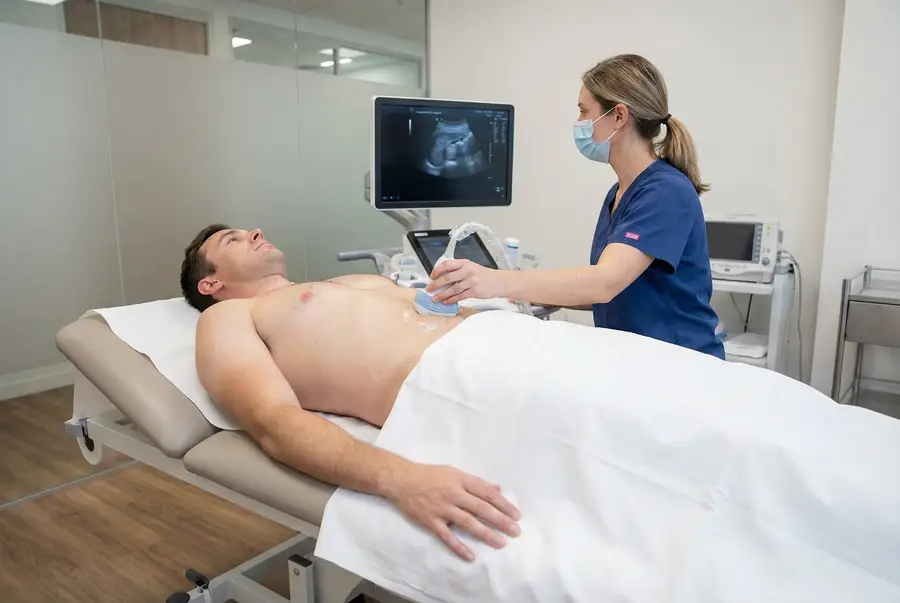
For an external scan, gel is applied and a probe is moved over the relevant skin. For an agreed transrectal examination, a cleaned and disinfected probe with a single-use cover and lubricating gel is gently placed in the rectum.
Images and measurements are recorded, with additional techniques where needed for the protocol. Tell the examiner if pressure or positioning causes pain. Any immediate clinical concern is managed through the centre’s escalation process.
Safety, duration and aftercare
Standard diagnostic ultrasound has no known harmful effects when used appropriately and uses no ionising radiation. An external scan is non-invasive; a transrectal examination involves an internal probe and can cause pressure or discomfort.
Many diagnostic appointments take around 15–30 minutes, although combined or specialist examinations may take longer. You can usually drive and return to normal activities afterwards unless advised otherwise.
Sampling, treatment, sedation or anaesthetic involves separate arrangements and may change the preparation, risks and aftercare. These are not automatically included in a diagnostic ultrasound booking.
Getting and understanding your results
Your scan images are reviewed by a consultant radiologist or relevant specialist clinician, who prepares a written imaging report. Results are usually available within three working days of the date of your scan. More complex examinations may require additional specialist review and can take slightly longer.
Once your results are available, a post-scan consultation will be arranged with the same medical doctor who conducted your pre-scan consultation. This continuity allows your doctor to consider the findings alongside the symptoms, medical history and concerns you discussed before your scan.
During the consultation, your doctor will explain the report in detail, answer your questions and discuss what the findings mean for you. Where further assessment or care is needed, they will explain the recommended next steps, which may include additional investigations, a specialist referral or follow-up with your usual healthcare team.
How much does a private ultrasound cost?
Private ultrasound scans with PrivateScans start from £195. This is our general ultrasound starting price. The confirmed cost depends on the centre, area examined, approach and specialist requirements.
A testicular examination, urinary tract scan and specialist prostate service may have different prices. Biopsy or treatment is not automatically included. Your consultation helps establish the appropriate investigation, and the examination and cost will be confirmed before you proceed.
Book an appropriate ultrasound examination
Your booking includes a 30-minute private telephone consultation with a medical doctor at a convenient time. You can discuss symptoms, medical history, previous investigations and any concerns about the examination.
Where routine outpatient ultrasound is clinically appropriate, a written referral is prepared and the team can help arrange a suitable service, subject to availability. Your report is discussed with the same doctor, who will explain the findings and any necessary next steps. Explore available ultrasound appointments or return to our ultrasound body parts directory.
FAQs
Is men’s ultrasound one combined scan?
No. It describes a range of examinations. Your referral and booking specify the area and purpose, such as a testicular, prostate or urinary tract assessment.
Will I need an internal examination?
Not for a routine testicular scan. Prostate imaging may be external or transrectal, depending on the question and service arranged. An internal examination requires explanation and your consent.
Can ultrasound rule out prostate cancer?
No. Clinical assessment, PSA, MRI and sometimes biopsy have different roles. A normal ultrasound does not replace an appropriate investigation of suspected cancer.
Can it assess a testicular lump?
It can help locate and characterise a lump. Some findings need prompt specialist assessment or other tests. A new lump should be reviewed rather than assumed to be harmless.
Should I book a routine scan for sudden testicular pain?
No. Sudden severe pain needs emergency medical assessment. Do not wait for an outpatient appointment or routine report.
Can ultrasound tell whether I am fertile?
Not by itself. It can identify selected structural findings, but fertility assessment may also require semen analysis, blood tests and clinical review.
Is a biopsy included?
Not automatically. Sampling is a separate procedure requiring a clinical decision, consent, preparation and its own reporting arrangements.
What’s included with your scan?
What is included with your scan:
- A pre-scan telephone consultation with a member of our medical team.
- A written medical referral prepared from the information discussed during your consultation, where clinically appropriate.
- Your scan at the chosen scanning centre.
- A written imaging report prepared by a consultant radiologist or relevant specialist clinician.
- Access to downloadable copies of your scan images where required.
- A post-scan consultation to discuss your results and next steps where needed.