Access appointments sooner
Explore available appointments at specialist centres. Your team will confirm suitable options and the earliest available date.
Explore an alternative to a conventional tunnel scanner if enclosed spaces, mobility or lying flat make MRI difficult. Your care includes a medical consultation, specialist reporting and a follow-up appointment to explain your results.
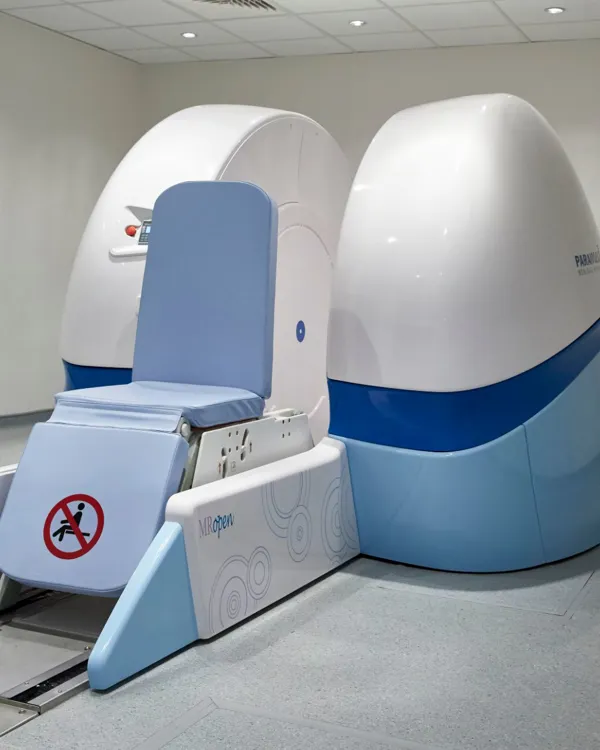
Discuss your needs with a medical doctor and explore a scanner suited to both your comfort and the clinical question, with support before and after your examination.
Explore available appointments at specialist centres. Your team will confirm suitable options and the earliest available date.
Selected scanners allow seated, reclining or other supported positions, depending on the body area and protocol.
Your booking includes a medical consultation. A written referral is prepared where MRI is clinically appropriate.
Starting price for one body part. The centre, scanner and agreed protocol determine your confirmed price before you proceed.
Open and upright options include selected centres in Birmingham and London. The right scanner and location are confirmed before booking.
Receive a specialist report, usually within three working days, and a consultation to understand the findings and next steps.
Scanner choice should support a successful examination while providing the information your doctor needs.
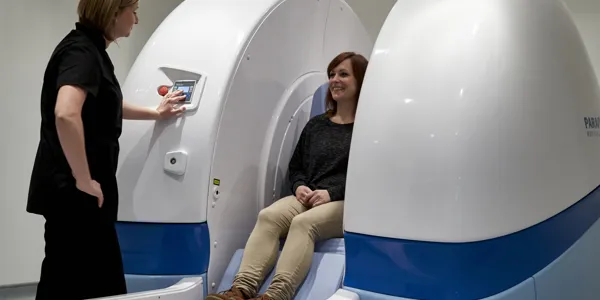
An open design can feel less enclosed than a conventional tunnel scanner. Tell us about anxiety or a previous difficult scan so the team can discuss the scanner layout, preparation and practical support.
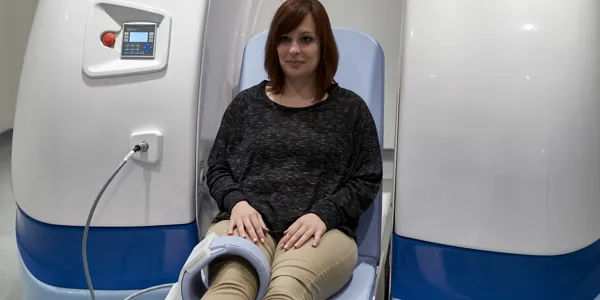
Some upright systems can obtain images in seated or weight-bearing positions. For selected spinal or joint concerns, your clinician may consider whether a position-related examination would provide useful additional information.
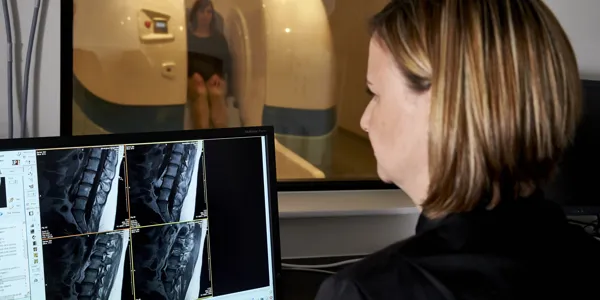
An alternative scanner may help if lying flat is difficult or a conventional scanner feels restrictive. Access, transfer arrangements, physical dimensions and the required imaging position are assessed individually.
The terms describe different designs. An open scanner does not automatically offer standing or weight-bearing imaging.
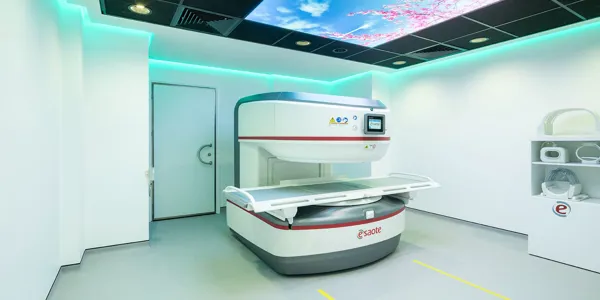
An open scanner has a more open-sided design than a conventional tunnel system. Many examinations are performed lying down, with the body area positioned between or beneath the magnets.
This layout may be more manageable if you find enclosed spaces difficult. The available examinations depend on the scanner, coils and protocol.
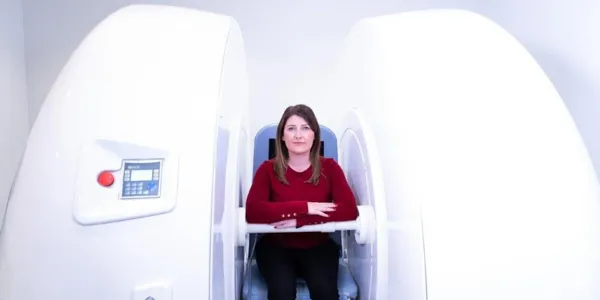
An upright system can support selected examinations in seated, reclining or other positions. Some systems also allow standing or weight-bearing imaging when specifically indicated.
The position is chosen for the clinical question and your ability to remain comfortable and still. Standing scans are a specialist option, rather than a feature of every open or upright appointment.
Like conventional MRI, these scanners use a magnetic field and radio waves to create detailed images inside the body. They do not use the ionising radiation involved in X-rays or CT scans.
The main difference is the design of the scanner and the positions it can accommodate. Receiving coils may be placed around the body area being examined, and you need to remain still during each sequence.
Open and upright systems can produce useful diagnostic images for many examinations. They are not interchangeable with every conventional MRI protocol: image quality and suitability depend on the scanner, body area and information required. Your referral is reviewed before the examination is agreed.
Depending on the centre and scanner, options may include selected examinations of the brain, spine, shoulder, knee, ankle and pelvic region.
Not every body area, specialist sequence or contrast examination can be performed on every open system. Some questions are better answered using a conventional scanner or another investigation. Our team will confirm the appropriate option before booking.
You can also explore all MRI body-part guides or read more about our standard MRI service.
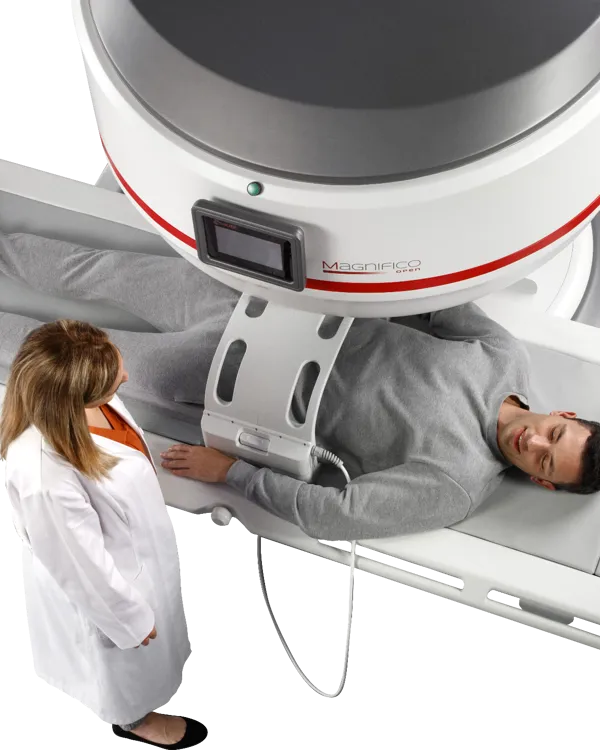
Tell us what made a previous scan difficult, or what concerns you about an upcoming examination. Your doctor and scanning team can consider the scanner design, the time you need to remain still and the practical support available.
For selected examinations, different positions may help assess symptoms that change with posture or loading. This must be clinically appropriate and agreed with the centre; you will not be asked to maintain a position that you cannot safely tolerate.
Music, visual surroundings and other comfort features vary between centres. The team can explain what is available at the proposed location.
Your results are usually available within three working days of your scan. A consultant radiologist or relevant specialist clinician reviews your images and prepares a written report. More complex examinations may require additional review and take slightly longer.
A post-scan consultation is then arranged with the same medical doctor who conducted your pre-scan consultation. Your doctor will explain the report in detail, answer your questions and discuss any necessary next steps.
Access to downloadable scan images is available where required for onward care. Any urgent finding is managed through the appropriate clinical escalation process.
Your medical consultation reviews your symptoms, previous investigations and the reason an open or upright scanner may be helpful. Tell the team about anxiety, pain, mobility restrictions and any difficulty lying flat.
MRI safety checks still apply. Disclose implants, pacemakers, previous operations, metal fragments, possible pregnancy, kidney problems and previous contrast reactions. Bring device information if requested; suitability must be confirmed before scanning.
The centre will also check relevant height, weight and body measurements, transfer needs and the space available around the body area. An open design does not remove equipment or positioning limits.
Follow the centre’s instructions on clothing, food, drink and medicines. You may need to change into a gown and remove jewellery, hearing aids and other unsuitable items.
A radiographer explains the examination, completes the safety screening and helps you into the agreed position. Supports and a receiving coil may be used around the area being examined.
The scan is taken as a series of sequences. You need to keep still while each sequence is recorded. You can communicate with the radiographer throughout, and hearing protection is provided as required.
Many appointments take around 45 minutes, but the duration depends on the body area, number of sequences and positioning. Your centre will confirm the expected scan and arrival times.
A routine scan usually allows you to resume normal activities afterwards. If contrast, sedation or another additional arrangement is proposed, the team will explain its preparation, cost and any aftercare separately.
We confirm scanner suitability and practical arrangements before you proceed.
Tell our team the body area and why you need an open or upright scanner.
Review your symptoms, medical history and the appropriate examination.
Agree the scanner, location, positioning, price and preparation.
Attend your agreed examination with the specialist imaging team.
Discuss your report and any necessary next steps with your original doctor.
Our team can help you understand the scanner options and confirm a suitable examination.
Contact our teamOpen MRI describes a scanner with a more open-sided design, often used with the patient lying down. Upright MRI describes a system that can support selected examinations in seated or other positions. Standing and weight-bearing scans require a suitable system and a specific protocol; they are not available for every examination.
Many people find the more open design easier to tolerate, but no scanner can guarantee that you will feel free of anxiety. The body area may still need a receiving coil and you must remain still. Tell the team about your concerns so they can explain the layout and discuss appropriate support.
Options include selected centres in Birmingham and London. The available scanner, body areas, positioning and appointment times vary by centre and are confirmed before booking. Please contact our team rather than assuming a standard MRI appointment includes an open or upright scanner.
Standing imaging is a specialist option for selected clinical questions. London standing examinations may be limited to lumbar spine protocols, and availability must be confirmed for your referral. An open scanner used for lying-down examinations does not necessarily support standing scans.
Yes. Limits depend on the scanner and required position. Some systems have a maximum weight of 200 kg, and selected upright systems have a width limit around 56 cm, but these figures are not a guarantee of suitability. The centre must confirm its current limits and assess the space needed for the body area, supports and receiving coil before booking.
Open and upright systems can provide diagnostic images for many examinations, but they do not perform every protocol in the same way as a conventional scanner. The field strength, coils, positioning and clinical question all matter. Your doctor and imaging team will confirm whether the proposed system can provide the information needed.
Scans start from £575 for one body part. This is a starting price rather than a fixed price for every location or examination. Your centre, scanner, body area and any additional requirements determine the confirmed cost, which is explained before you proceed.
You do not need to obtain a referral from your usual GP beforehand. Your booking includes a medical telephone consultation, and a written referral is prepared where the proposed examination is clinically appropriate. The centre also confirms scanner suitability and MRI safety requirements.
Your booking includes a pre-scan medical telephone consultation, a written referral where appropriate, your agreed examination at the chosen centre and a written specialist imaging report. Images are available to download where required. A post-scan consultation is arranged to explain the findings and any necessary next steps.
Many open or upright MRI appointments take around 45 minutes, although this varies with the examination and the positions needed. Your centre will confirm how much time to allow, including preparation, and when to arrive.
An open scanner still has a strong magnetic field. All implants, devices and metal fragments must be checked using the centre’s MRI safety process. Some devices can be scanned only under specific conditions, and suitability for one MRI system does not automatically establish suitability for another.
Results are usually available within three working days from the date of your scan. More complex examinations may take slightly longer. A post-scan consultation is arranged with the same doctor who conducted your pre-scan consultation to explain the findings and discuss any necessary next steps.
Speak to our team about your symptoms, comfort and mobility needs. We will help confirm whether an open or upright scanner is appropriate and explain the available locations and next steps.
Book Upright MRI Scan