No GP referral needed
Start your booking online or by phone. Our doctors can review your needs and support the referral process where imaging is appropriate.
Detailed MRI imaging for brain, spine, joints and soft tissue concerns, with doctor-led referral support and consultant radiologist reporting.
PrivateScans helps you access clinically appropriate MRI imaging across the UK, with medical support before and after your appointment.
Start your booking online or by phone. Our doctors can review your needs and support the referral process where imaging is appropriate.

Access MRI appointments through a network of 100+ CQC-registered clinics across the UK.

Appointment availability is often within a few days, depending on the body area, clinic and location selected.

Your MRI images are reviewed by a consultant radiologist, with a formal written report provided after your scan.

A GP follow-up consultation helps you understand your report and consider the most appropriate next steps.

Clear scan costs are explained before your appointment is arranged, so you understand the price before you commit.

Explore nearby scan centres and prices, or get help choosing the right scan.

Book your pre-scan consultation and complete your medical questionnaire before the appointment.

During a telephone consultation, an experienced GP will review your symptoms and medical history, confirm the most appropriate scan and issue your referral.
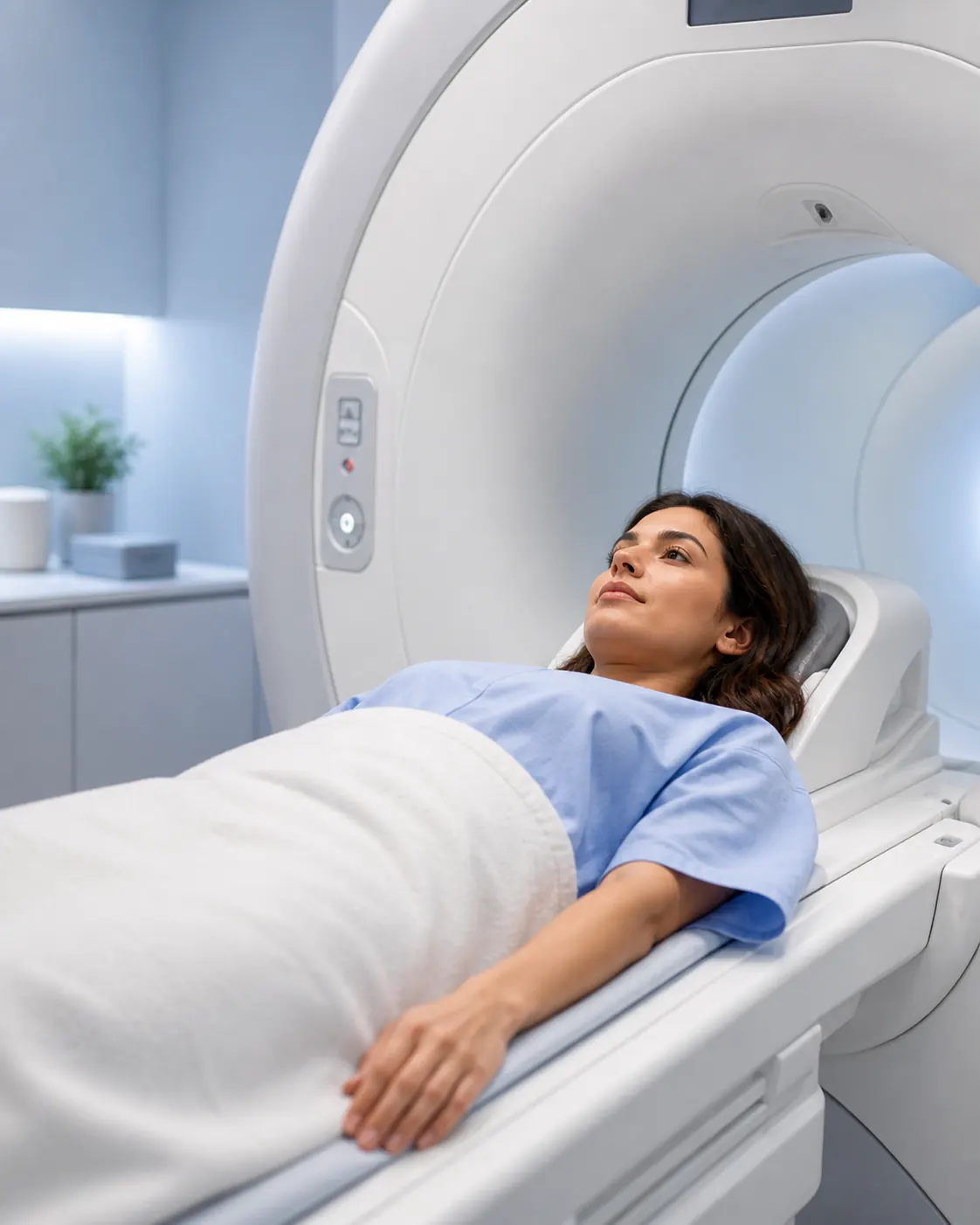
Attend your scan at one of our partner CQC-registered scanning centres, selected for convenience and high clinical standards.
Results arrive fast. A follow-up consultation with a GP will explain your results and guide you on what to do next if needed.
MRI scans provide a safe and comprehensive diagnostic tool. The availability of different scan types ensures you can receive the most accurate and relevant information for your health condition.

Whole-body MRI overview for broad health screening where clinically appropriate.
Learn more
Detailed pelvic imaging to assess soft tissues, bones and nearby organs.
Learn more
Focused liver imaging for selected liver, bile duct or abdominal concerns.
Learn more
Lower limb imaging to assess muscles, bones, joints and soft tissues.
Learn moreCalf MRI can help assess muscle, tendon or soft-tissue symptoms.
Learn more
Chest MRI may be used for selected chest wall, mediastinal or soft-tissue concerns.
Learn more
MRCP is a specialist MRI scan of the bile ducts, gallbladder and pancreatic ducts.
Learn more
Detailed imaging of the brain and head for neurological symptoms or injury.
Learn more
Adrenal imaging can help assess abnormalities around the adrenal glands.
Learn more
Lower back MRI to assess discs, nerves, joints and surrounding tissues.
Learn more
Imaging of the foot, ankle, tendons, ligaments and related bones.
Learn more
Hip MRI to assess joint, bone, tendon and soft-tissue problems.
Learn more
Specialist MRI imaging of the small bowel where clinically indicated.
Learn more
Neck MRI can assess soft tissues, glands, lymph nodes and related structures.
Learn moreNeck spine imaging to assess discs, nerves and the spinal canal.
Learn more
Imaging around the thyroid and surrounding neck structures where appropriate.
Learn more
Specialist MRI imaging of the heart structure, muscle and function.
Learn more
Hand MRI can assess bones, joints, tendons, ligaments and soft tissues.
Learn moreFocused MRI of the pituitary region and surrounding structures.
Learn more
Kidney MRI can assess renal structures and selected abdominal concerns.
Learn moreAchilles MRI can help assess tendon injury, inflammation or degeneration.
Learn more
Temporomandibular joint imaging for jaw joint pain or movement concerns.
Learn moreSpine MRI can assess discs, nerves, vertebrae and the spinal canal.
Learn moreSinus MRI can assess selected sinus and facial soft-tissue concerns.
Learn more
Shoulder MRI can assess rotator cuff, labrum, bone and joint problems.
Learn more
Orbit MRI gives detailed imaging around the eyes and optic nerves.
Learn moreCoccyx MRI can assess tailbone pain, injury or nearby soft tissues.
Learn moreSpecialist imaging may be used for selected testicular or pelvic concerns.
Learn more
Mid-back MRI to assess discs, nerves, vertebrae and soft tissues.
Learn more
Elbow MRI can assess tendons, ligaments, joint surfaces and soft tissues.
Learn more
Wrist MRI can assess ligaments, cartilage, tendons and small bones.
Learn moreAbdominal MRI provides detailed imaging of organs and soft tissues.
Learn more
Knee MRI can assess meniscus, ligaments, cartilage, bone and tendons.
Learn moreBook a consultation call with one of our doctors for expert scan advice. If imaging is recommended, we can support the referral and help you choose the most appropriate MRI.
Speak to a doctorAn MRI scan is a non-invasive imaging test that uses a powerful magnetic field and radio waves to create detailed images of the inside of the body. It is particularly useful for soft tissues, joints, the brain, spine, abdomen and pelvis.
The scan time varies depending on the body area and whether contrast is required, but many MRI scans take between 15 and 90 minutes.
MRI does not use ionising radiation. Instead, it uses magnets and radio waves. For many patients this makes it a suitable and safe imaging option.
MRI is not suitable for everyone. Certain implants, pacemakers, metal fragments or medical devices may mean MRI is unsafe or requires specialist checks. Pregnancy and contrast use also require careful clinical review.
An MRI can help investigate pain, injury, inflammation, neurological symptoms, suspected soft-tissue problems and changes in organs or joints. It can support diagnosis, treatment planning and decisions about onward referral.
Brain and neurological concerns
Disc, nerve and spinal problems
Joint, tendon and ligament injuries
When you book a private MRI scan, you'll receive a full, end-to-end package of care, starting from just £299.
Our scan costs vary depending on the pricing set by the individual scanning centres.
Your total scan price includes the pre-scan GP consultation, scan, consultant radiologist’s report, scan images and post-scan GP consultation. A £25 consultation fee is payable when you book; if you decide not to proceed with the scan, the £25 consultation fee remains payable.
Explore ScansDuring a telephone consultation, a GP reviews your symptoms, confirms the appropriate scan and prepares your medical referral.
Your appointment is arranged at a trusted registered scanning centre.

Your images are reviewed and formally reported by a consultant radiologist.

A doctor can explain your report and advise on appropriate next steps after the results.
Access to scan images can be arranged where needed for onward care.
Common questions about private MRI scans, preparation, safety and results.
An MRI scan allows medical professionals to study the inside of your body and can help provide a diagnosis or guide a treatment plan where required.
Our clinical team will speak with you one-to-one to understand your medical needs and help ensure you receive the right diagnostic scan quickly and efficiently.
After your scan, a radiologist will examine your images and compile a report of their findings.
The radiologist then sends the results to our clinical team. This can take up to a week depending on the clinic and scan complexity. Our team will review your results and email a copy to you.
MRI scans are performed by radiographers, who are highly trained specialists. They will explain the procedure beforehand, then speak to you via headphones during the scan.
You will need to lie very still on a motorised flat bed, which moves in and out of the scanner. The scanner is noisy, so you may be able to listen to music to help you relax. Most scans take between 15 and 90 minutes depending on the area being scanned. Some scans require contrast material to help generate more defined images, usually given by IV.
MRI scans have a wide range of uses. Alongside general body imaging, specialist scans may include multiparametric prostate MRI for detailed prostate imaging, magnetic resonance angiography for blood vessel imaging, and cardiac MRI for heart imaging.
There are also different scanner types. The most common is a cylindrical closed-bore scanner. Claustrophobic patients or those with reduced mobility may be suitable for open or upright scanners, depending on availability. MRI machines can also vary in magnet strength, such as 1.5T or 3T.
MRI scans are safe and non-invasive, and preparation is usually minimal. We will let you know ahead of time if you need to avoid eating or drinking before your appointment.
The scanner’s strong magnets can interact with metal objects, so we recommend soft, comfortable clothing with no metal fastenings. You may be asked to remove glasses, belts, watches, jewellery, dentures and hearing aids, and you may be asked to change into a medical gown.
Get fast access to MRI appointments across the UK, with doctor-led guidance, consultant radiologist reporting and follow-up support after your results.
Explore Scans